


9 - Reflection as Mirror — Seeing Yourself Through Others Without Losing Ground
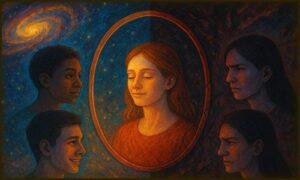
The Settlor stands in the world not as an island, but as one who is constantly reflected through the lives of others. Every interaction, every word, every look becomes a kind of mirror, offering back some aspect of yourself. These reflections are not always easy to face. Some are flattering, others confronting; some distort, others reveal with surprising clarity. To walk the Settlor path is not to reject these mirrors, but to engage them with discernment — to recognize what they reveal, while remaining rooted in your own ground.
The danger lies in losing yourself to the reflection. When you forget that you are the author, not the reflection, you may be carried into roles, expectations, or judgments that were never yours to hold. The gift, however, is profound: when engaged rightly, reflection from others can refine your clarity, deepen your sovereignty, and expand your capacity for self-understanding without compromising your true authentic self.
Mirrors of Truth — Recognizing Yourself in the Reflection of Others
Every person you meet becomes a mirror. Sometimes they reflect your strengths, sometimes your wounds, and sometimes your blind spots. These mirrors are not always faithful — some distort through their own fears or projections — yet even distortions carry messages. The Settlor learns to discern not only what is reflected but how to read the mirror itself. A compliment may reveal not just your gift, but the place where you have resisted acknowledging it. A criticism may sting, yet beneath it may lie a kernel of truth that helps refine your path.
Mirrors are not about dependency but about revelation. Others cannot define who you are, yet they can help illuminate corners of yourself that you could not otherwise see. IF, you are willing to be very honest. The Settlor embraces this with humility, recognizing that the reflections offered by others are part of the broader design of growth under the Lor of Nature. They are instruments, not authorities. They help you see, but they do not author your being.
To recognize yourself in reflection requires honesty. It is tempting to dismiss every criticism as projection or to accept every praise as truth. But the Settlor does not grasp or deny — instead, you sift, you listen, you ask: what in this mirror belongs to me, and what belongs to them? This act of discernment itself sharpens clarity, deepening your trust in your own inner seeing.
When you engage mirrors rightly, you discover gifts you had overlooked and shadows you had ignored. Both are necessary. Gifts call you to walk more fully in authoring your own story; shadows invite you to step out of concealment and back into alignment. Without mirrors, both may remain hidden, and your authority less grounded.
Thus, mirrors are not threats but companions. They remind you that your ground of being is not built in isolation but refined in the dance of relationship. The Settlor who welcomes these reflections — without surrendering authority — grows in both clarity and strength.
Reflective Questions – Mirrors of Truth
What recent interaction revealed something about me that I had not seen before?
How do I tend to respond to mirrors that show me my shadow?
Do I dismiss reflections too quickly, or do I absorb them without discernment?
What truths about myself have only become clear through the eyes of others?
How do I remain the Settlor while engaging with these reflections?
Holding Ground — Receiving Reflection Without Losing Authority
Mirrors can be powerful, but they can also become traps if you confuse the reflection for the self. The Settlor must remember: the authority rests not in the mirror, but in the ground you stand on. Others may reflect pieces of you, but they cannot hold your center. If you forget this, you risk living for validation, praise, or even criticism — shaping yourself to the mirror instead of to the inner Lor.
To hold your ground means to engage with reflection while remaining rooted in self-authoring. You allow the mirror to reveal but do not hand over your authority to it. This requires steadiness. For example, when someone praises you, you may feel lifted — but you do not become defined by their approval. When someone criticizes you, you may feel pain — but you do not become diminished by their disapproval. In both cases, you remain the Settlor: one who receives, considers, and chooses.
Holding ground also protects against distortion. Every mirror carries the other person’s story, their wounds, their desires. Sometimes what they reflect says more about them than about you. If you absorb this uncritically, you risk living under someone else’s authored story. But if you remain grounded, you can receive what is useful and release what does not belong to you.
This is not a posture of defensiveness but of openness with discernment. To shut out every reflection would be to isolate yourself; to swallow them whole would be to lose yourself. The Settlor walks the middle way: open enough to be taught, steady enough not to be displaced. In this way, you allow mirrors to polish your clarity without eroding your foundation.
Ultimately, holding ground affirms that the final word belongs not to the mirror but to the Lor you live by inside with Source. Others may reflect pieces of your journey, but they do not define it. By standing firmly in your own ground, you honor both the truth others reveal and the truth that only you can live.
Reflective Questions – Holding Ground
Where do I notice myself living for the approval or disapproval of others?
How can I stay open to reflection without letting it rewrite my ground?
Which reflections in my life might be more about the other person than about me?
What practices help me return to my ground after being shaken by feedback?
- How do I remember that my final accountability is to the inner Lor, not to others’ mirrors?
Closing Reminder
Mirrors are part of the path, but they are not the path itself. They reveal, but they do not author. The Settlor engages them with openness and discernment, seeing what they offer without losing the ground of self-authority under the Lor of natural balance. In this balance, mirrors become tools of refinement rather than sources of confusion. To see yourself through others without losing yourself is to walk with clarity, rooted and free.