


8 - Building in the Living Field
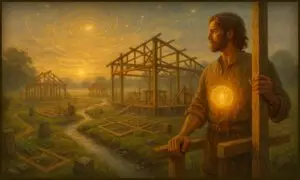
The Living Field does not remain internal. It yearns for form — for embodiment in structures, processes, and relationships that express the Settlor’s flame. To build is not merely to construct. It is to externalise sovereignty, to bring the invisible into shape, to let intention touch the earth. In this part of the path, the Settlor shifts from inward clarity to outward manifestation. The flame must now become form.
To build in the Living Field is to craft life itself — how we organise time, how we relate to others, how we tend land, how we set up systems that reflect our deepest values. Whether simple or complex, these structures become extensions of the inner flame. And if they are built in truth, they do not trap us. They support us. They do not own us. They express us. A poorly aligned system can suffocate sovereignty — but a conscious system can amplify it.
Part 8 explores two aspects of building:
First, how the Settlor manifests sovereignty through structures and processes that align with their values
And second, how they build community as the outer arc of the inner flame — not through obligation, but through shared clarity
This is where intention takes root. This is where vision becomes real. This is where freedom becomes functional.
Manifesting Sovereignty through Structures and Processes
Sovereignty without structure dissolves. Vision without process drifts. The Settlor understands that inner clarity must become outer form — not through force, but through conscious design. To build is not to confine, but to express. In this way, building becomes a sacred task: the translation of flame into frame. The structures we create — whether homes, homesteads, time systems, agreements, contracts, or workflows — are the visible geometry of the inner flame.
The Settlor does not reject structure; they redeem it. They ask: Does this structure honour life? Does it reflect truth? Does it support clarity, or demand obedience? This is the difference between a living form and a dead system. A dead system dominates and forgets the soul. A living form breathes with the purpose it was born to serve. The Settlor uses structure as a vessel, not as a master. The form holds the flame — but the flame is always primary.
To manifest sovereignty is to design life intentionally. That may mean shaping one’s daily rhythm to match inner clarity. It may mean creating clear agreements with others, choosing tools that support autonomy, or designing systems that support long-term vision. It may mean saying no to inherited defaults — whether social, digital, or familial — and crafting processes that reflect what is real now. The Settlor does not adopt by default. They architect by awareness.
This building is often invisible to the world. It happens in calendars, in routines, in documents, in conversations. It’s the way we schedule our time, handle our finances, run our projects, care for our bodies, respond to conflict. Each of these is a field of practice — and the one who shapes them with intention is already building sovereignty into the Living Field. The structures don’t have to be perfect — they have to be aligned.
Over time, these processes become a kind of nervous system for the Settlor’s life — responsive, intelligent, grounded. They support flow without collapse. They offer reliability without rigidity. And as life changes, the Settlor adapts their structures without betraying their flame. This is what makes the Settlor capable — not just of dreaming freedom, but of holding it.
Reflective Questions – Manifesting
- What current structures in my life feel aligned with my sovereignty — and which ones feel inherited or limiting?
- In what ways am I resisting process or system-building because of past experiences with control?
- How can I create agreements, systems, or rhythms that reflect the truth of who I am now?
- Where am I still waiting for freedom to “just happen” instead of designing the conditions that support it?
- What one structure could I build or revise this month to better support my path as a Settlor?
Community Building as the Outer Arc of the Inner Flame
The flame of the Settlor is not only personal — it is relational. While it begins within, it inevitably arcs outward, seeking expression in the shared field. Community building is not a retreat from sovereignty, but its extension. When done with intention, it becomes the outer arc of the inner flame — a structure where presence, clarity, and trust are made visible between people, not just within. In this way, community is not a group of bodies — it is a field of resonance.
To build community as a Settlor is to reject both domination and co-dependence. It is to stand as a whole person among other whole people — not collapsing, not controlling, but collaborating. The Settlor does not build around popularity or approval. They build around shared values, shared rhythm, shared agreements. These are the bricks and mortar of the communal field. And without them, the flame flickers — no matter how noble the vision.
Community begins not with outreach, but with embodiment. The clearer the Settlor is within themselves, the more naturally they attract others who are walking the same direction. They do not need to sell the path. They need only live it. Those who resonate will find their way. And from there, the building begins: through spoken agreements, shared tasks, mutual processes, conflict resolution, and celebration. All of it becomes part of the structure — and all of it, sacred.
But this work is not always smooth. Real community is not built on idealism. It is built through tension, through learning, through coming back to the flame when things crack. The Settlor who builds outward must be willing to revisit inner alignment constantly — lest the community drift into performance, hierarchy, or collapse. This is why community building is a sovereign act: it requires each person to remain at home within themselves, even while moving in relationship.
The outer arc of the flame is not the spreading of influence. It is the offering of a shared space where truth can breathe. A place where each person can bring their flame — not to compete, but to contribute. And when this is done well, something remarkable emerges: a structure that strengthens each individual, without owning any of them. This is the shape of living trust. This is the echo of the flame, becoming many — without losing itself.
Reflective Questions – Community Building
What values do I want to see reflected in the communities I build or join?
How do I currently navigate power, responsibility, and boundaries in group dynamics?
Am I more likely to shrink, dominate, or stay centred when in shared space?
- What communal structures (agreements, rhythms, roles) would support a sovereign space?
- How might I begin or refine the process of building a relational field rooted in clarity?
Closing Reminder
To build is to bless the unseen with shape. The Settlor does not keep their sovereignty in abstraction. They walk it into the world — into systems, agreements, dwellings, relationships, processes. They give it edges without losing its essence. This is the act of maturity: translating inner clarity into outer reliability.
Let every form you build reflect your truth. Let every structure you craft carry the rhythm of your flame. Do not fear structure — redeem it. Do not fear others — walk with them from your centre. The Living Field expands not through declarations, but through what is actually built. One beam. One choice. One agreement at a time.
The flame is no longer hidden. It is rising now — and it is taking shape.